




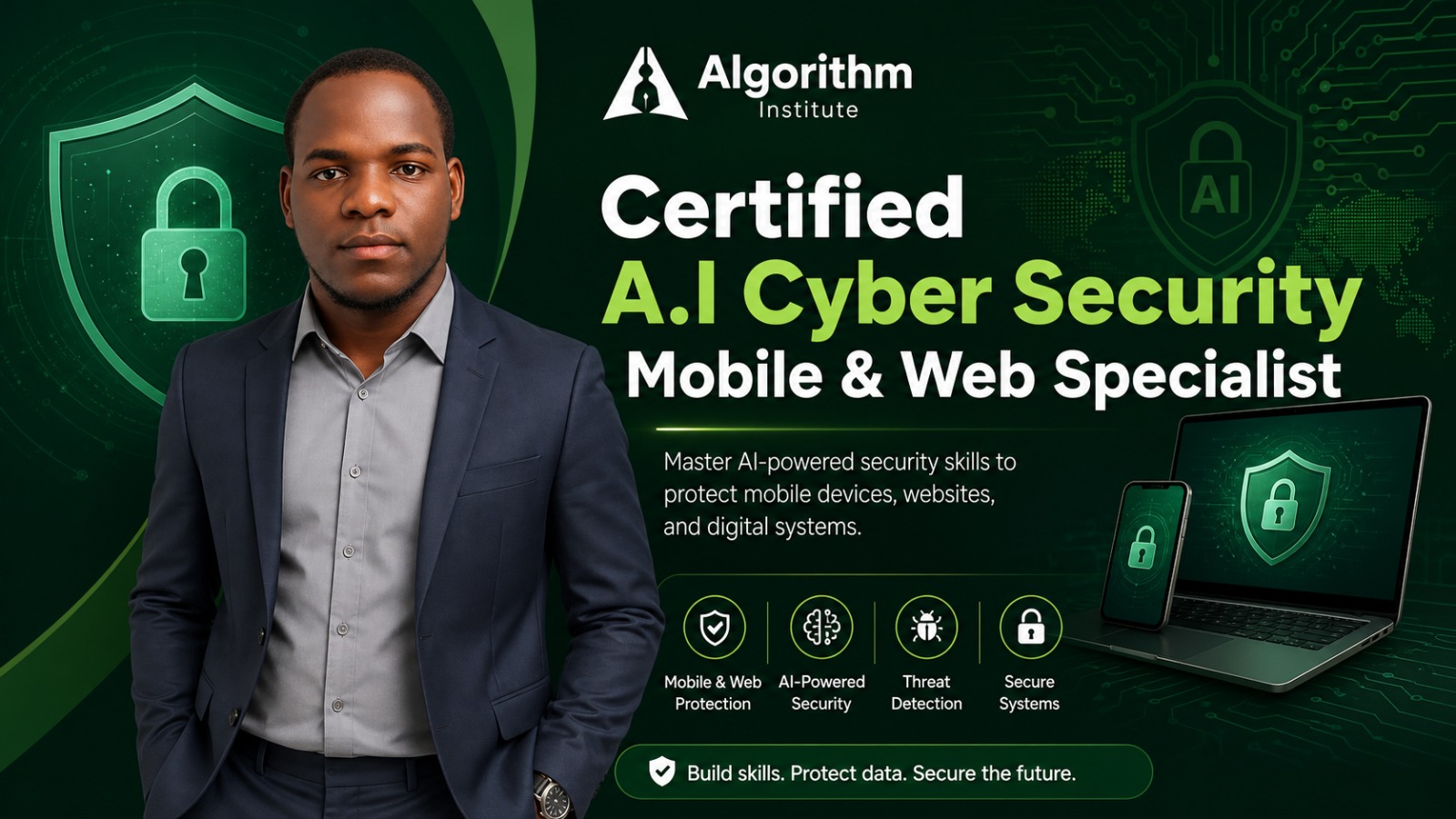
Basic Certificate in A.I Cybersecurity Mobile and Web Specialist
About This Course
Cybersecurity has become one of the most important skills in today's digital world. Every day, individuals and organisations rely on computers, smartphones, cloud platforms, websites, and online services that must be protected from cyber threats.
The Basic Certificate in A.I Cybersecurity is designed for beginners who want to build a strong understanding of cybersecurity without requiring prior technical experience. Throughout this four-week programme, students develop practical skills for securing personal accounts, protecting mobile devices, browsing safely, understanding how networks and websites operate, identifying common cyber threats, and applying industry-recommended security practices.
The course introduces learners to cybersecurity ethics, legal responsibilities, malware, phishing, social engineering, password management, multi-factor authentication, endpoint protection, networking fundamentals, HTTPS, SSL/TLS, cloud security, firewall concepts, and professional security reporting. Artificial Intelligence is integrated throughout the course as a responsible learning and research assistant, helping students improve their understanding while maintaining ethical and professional standards.
Rather than focusing only on theory, the programme combines structured lessons with quizzes, practical assignments, and a capstone project that allows students to apply what they have learned in real-world scenarios. Upon completion, learners will have established a strong cybersecurity foundation and gained practical skills that prepare them for more advanced cybersecurity studies and professional development.
Learning Outcomes
By the end of this course, students will be able to:
• Explain the core principles and importance of cybersecurity.
• Identify common cyber threats, attack techniques, and security risks.
• Apply ethical and legal cybersecurity practices.
• Secure personal accounts using strong passwords, password managers, and multi-factor authentication.
• Protect Android and iOS devices using recommended security settings.
• Practice safe web browsing and understand browser privacy concepts.
• Configure basic antivirus and endpoint protection.
• Understand networking fundamentals, including IP addresses, DNS, ports, protocols, and client-server communication.
• Explain HTTPS, SSL/TLS certificates, website trust, and secure communications.
• Understand basic firewall concepts and access control.
• Apply cloud security best practices using the shared responsibility model.
• Document security findings in a clear and professional report.
• Complete a Personal Cybersecurity Protection Setup project demonstrating practical cybersecurity skills.
Target Audience
This course is designed for:
• Beginners with little or no cybersecurity experience.
• Students interested in cybersecurity or information technology.
• Professionals seeking to improve digital security awareness.
• Business owners and entrepreneurs who want to protect their organisations.
• Remote workers and freelancers handling sensitive information.
• Anyone interested in building practical cybersecurity knowledge and establishing a strong foundation for advanced cybersecurity learning.
Prerequisites
No previous cybersecurity experience is required.
Students should have:
• Basic computer literacy.
• Access to a Windows, macOS, or Linux computer.
• A smartphone (Android or iPhone).
• Internet access for online activities and research.
• A willingness to learn and practice cybersecurity responsibly.
FAQ
Check the frequently asked questions about this course.

Abdulmuheez Qazeem

Course Specifications


Subscribe to Our Newsletter





Reply to Comment